top of page


introduction to
Botulinum Toxin Injections
Botulinum Toxin: The Gold Standard in Non-Surgical Facial Rejuvenation
Botulinum toxin type A (Botox®) is one of the most trusted and clinically proven treatments for correcting and preventing dynamic facial wrinkles. It temporarily relaxes the muscles behind expression lines such as glabellar frown lines, forehead lines and crow's feet, which makes it a refined, non-invasive approach to facial rejuvenation.
Used as part of a long-term treatment plan, botulinum toxin type A can also improve facial symmetry, subtly lift key features and delay wrinkle formation. It causes minimal discomfort, needs no downtime and gives consistent results, which is why it remains a cornerstone of aesthetic medicine.
Clinically Supervised Botulinum Toxin Training for Physicians
MASA offers training in botulinum toxin type A injection for physicians who are adding aesthetic medicine to their practice. The program is built like a supervised clinical rotation: set learning objectives, hands-on practice under a supervising physician, and a formal evaluation at the end. It includes about 4 hours of theory (in person or online), followed by 2 days of hands-on practice on patients, with an extra day available if needed.
Learning objectives:
-
Master the facial anatomy and neuromuscular function relevant to injection
-
Assess each patient and plan injection points and dosage
-
Apply safety protocols and recognize and manage complications
-
Document each treatment properly in the medical record: consent, product, lot number, dose and injection sites
-
Get natural, reproducible results
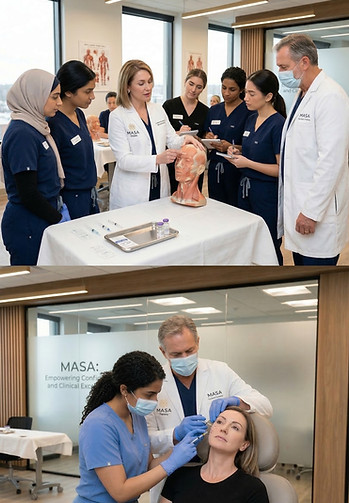

Competence, Safety and Clinical Judgment
Our goal is to train physicians who combine technical precision with ethical responsibility. Patient safety guides every step of the training and every evaluation. When you finish, you'll be able to carry out each procedure on your own, with clear judgment and to the standard your patients expect.
Introduction to
Hyaluronic Acid Injections
Hyaluronic Acid Fillers: Restore, Enhance, Rejuvenate
Hyaluronic acid (HA) dermal fillers are among the most requested non-surgical treatments in aesthetic medicine. HA occurs naturally in the body and helps maintain skin hydration, elasticity and volume.
Injected correctly, HA smooths fine lines, restores lost volume and refines facial contours without surgery or downtime. It's safe, versatile, well documented and reversible with hyaluronidase.
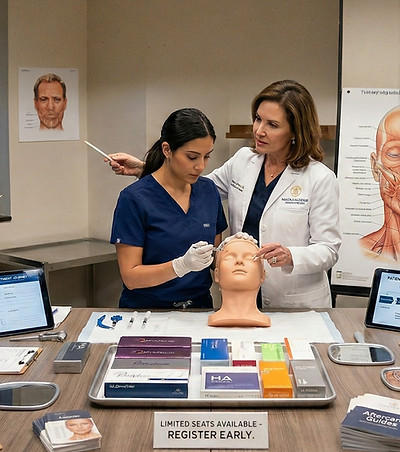
Supervised Hyaluronic Acid Filler Training
This course covers HA fillers from theory to independent practice. You'll learn the main HA products available, their rheological properties and how to choose the right one for each area and patient profile. The course includes about 4 hours of theory (in person or online), followed by 2 days of hands-on practice on patients, with an extra day available if needed.
Learning objectives:
-
Facial mapping and the danger zones (vascular anatomy)
-
Needle and cannula techniques
-
Preventing, recognizing and urgently managing complications, including vascular occlusion and hyaluronidase protocols
-
Consultation, informed consent and aftercare
Training is hands-on with a small number of participants per supervisor, so places are limited. Register early.
Confidence Built on Knowledge and Precision
When you finish, you'll be able to take a patient through the whole treatment process on your own, from consultation to follow-up, with safe, personalized results.
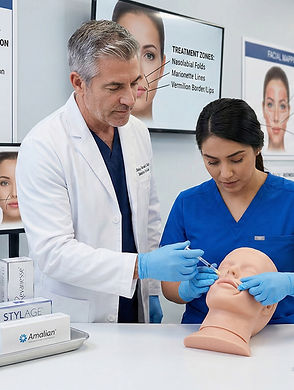
How the Training Works
Each course (Botox and fillers) has two parts: about 4 hours of theory, in person or online, followed by 2 days of hands-on clinical training injecting real patients under the supervision of a physician. An extra day can be added if needed. Taking both courses usually means 4 to 6 days of hands-on training in total.
1. Defining your objectives. Before you start, we look at your background and experience together and set clear learning objectives.
2. Part 1: theory and directed reading (about 4 hours per course, in person or online). Your trainer recommends selected readings and theoretical modules to complement the clinical practice.
3. Part 2: hands-on practice with patients (2 days per course, plus an optional extra day). Over these days, supervision moves forward in three steps:
-
Observation: you watch the trainer perform the procedures.
-
Direct supervision: you inject while the supervising physician is beside you.
-
Increasing independence: you lead the procedure while your trainer checks your judgment and technique.
The supervising physician remains responsible for the patients treated during the training.
4. Case discussions and feedback. After each procedure, you go over the case with your trainer and get specific feedback.
5. Mid-course feedback. Halfway through, you get verbal feedback on your strengths and what you still need to work on, so nothing at the final evaluation comes as a surprise.
6. Final evaluation and certification. Your trainer assesses each objective as fully met, partially met or not met. When the objectives are met, you receive your MASA certificate of training. If something remains to be worked on, we suggest additional supervised sessions.
7. Ongoing support. After the course, our team stays available to answer your clinical questions.
Requirements for Physicians
-
An active licence to practise issued by the Collège des médecins du Québec
-
Professional liability insurance in force
-
Confidentiality: everything about the patients treated during the training stays confidential
Note: Under the CMQ's Règlement sur les stages et les cours de perfectionnement pouvant être imposés aux médecins, a physician who begins practising in a field where they have never practised must notify the Secretary of the Collège of that change. Physicians adding aesthetic medicine to their practice should make sure they meet this obligation.


bottom of page